
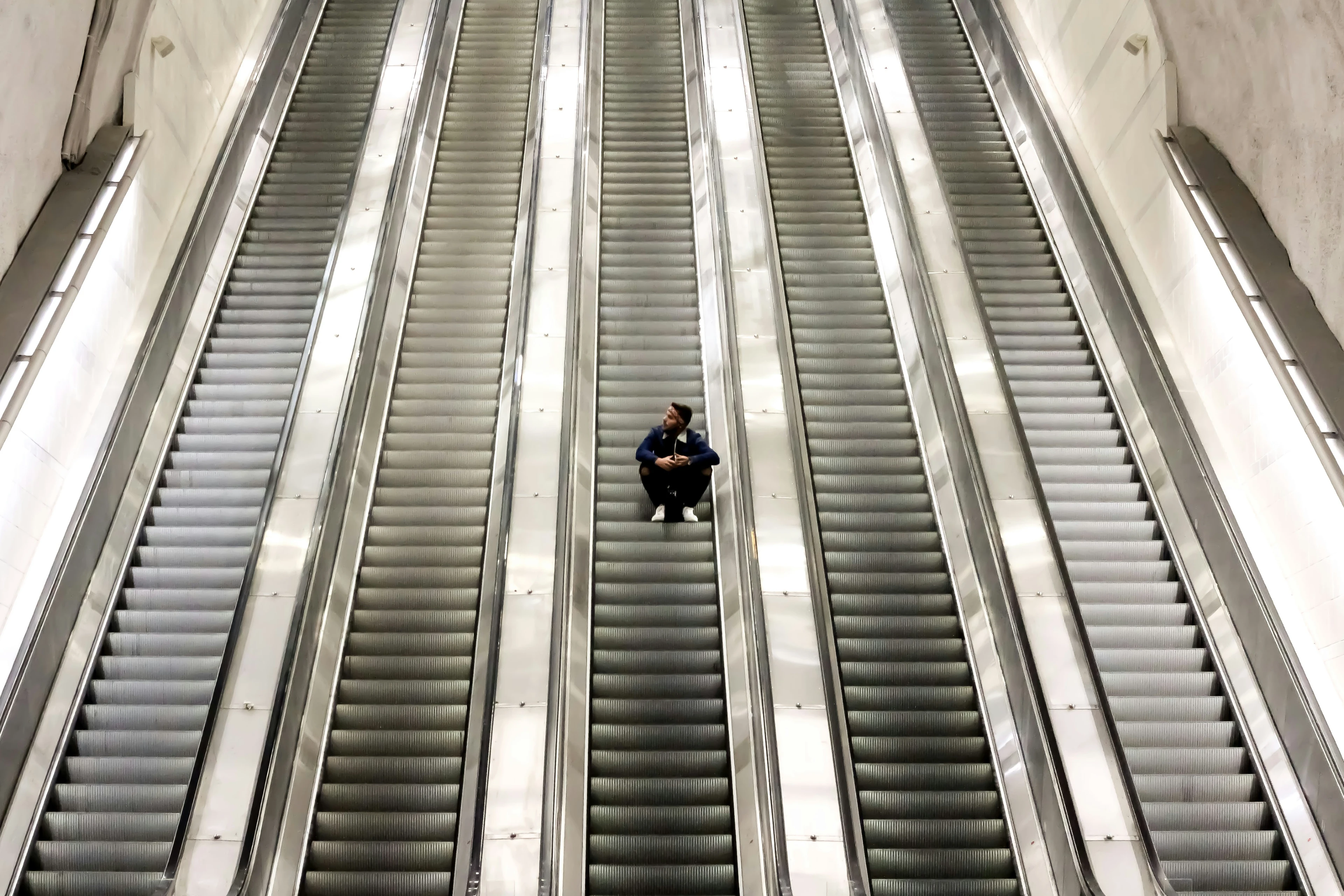
Person sitting on an escalator. Photo: Alejandro G. / Unsplash.
When the station is still a commute
Getting to Jamaica, Queens from Grand Central Station now only takes approximately 20 minutes after the opening of the Grand Central Madison concourse – An $11.6 billion expansion of the famous train station allowing Long Island Railroad trains to terminate under Madison Avenue instead of Penn Station. 1.5 million passengers per month now make the trip across the East River from Grand Central, and marketing for the project suggested that commuters to Manhattan’s east side would save up to 20 minutes per trip.
These estimates may have been optimistic. Commuters quickly learned that at 140 feet (43 m) underground, Grand Central Madison was still a commute, just one that moved vertically rather than horizontally. In fact, local New York blog “The Gothamist” tested this to see just how much time was really saved when you accounted for vertical circulation. Using the 4/5/6 train platforms at Grand Central as the destination point, it took their writers 11 minutes and 20 seconds to get there from the LIRR Grand Central Madison terminal. Getting there from the LIRR Penn Station platforms and travelling east via the Times Square Shuttle took 13 minutes, reducing the time savings from a claimed 20 minutes to a mere 1 minute and 40 seconds.
These estimates may still overestimate the impact of Grand Central Madison in terms of time savings. In transport demand modelling and economics, it’s common practice to use time perception factors as part of any calculation to determine time savings. A journey where you get a seat feels less onerous than a journey where you’re standing. Time on an empty train doesn’t feel as long as time on a crowded train. Time waiting for a vehicle feels longer than time that you’re moving on a vehicle to your destination. Importantly for this New York terminus question, time spent walking is traditionally valued at twice as onerous as time on vehicle. The USDOT guidance on the valuation of travel time recommends a factor of 2 when comparing walk to on vehicle time. Using these suggested weighting parameters would actually imply the trip from Penn Station would feel faster than the trip from the depths of Grand Central.
Of course, this would assume the Times Square Shuttle isn’t crowded, which may be extremely optimistic. It’s quite possible the crowding perception from that shuttle would negate the walking perception in Grand Central. Whether Penn Station or Grand Central Madison is preferable, the key thing is that the difference between them is extremely marginal, even for those whose destination is at or east of Grand Central. Even assuming all 1.5 million monthly passengers received the complete 100 seconds of benefit with ridership growing at 2% per year at the 2026-inflated USDOT recommended value of $22.43 per hour and a 3.1% discount rate over a 60-year period, this would imply an optimistic travel time savings value of approximately $500 million on a project that cost $11.6 billion.
This is not some side impact of Grand Central Madison – Improvements to travel time were one of the primary goals alongside increasing capacity, and yet the functional travel time improvements are worth approximately 4.3% of what was spent to build the project.
The hidden cost of going deeper
It is far too common to think of access and egress time as an afterthought when building projects. In the case of Grand Central Madison, it reduced the claimed time savings benefits by 83% per trip. New York also recently built phase one of the Second Avenue Subway, with its stations 100 ft (30 m) below the surface. The Ontario Line under construction in Toronto reaches a depth of 131 ft (40 m). The LA Metro D Line extension is 75 ft (23 m) deep. Virtually all new underground tunnels in North America are being built at depths that were once considered unusual, but are now commonplace.
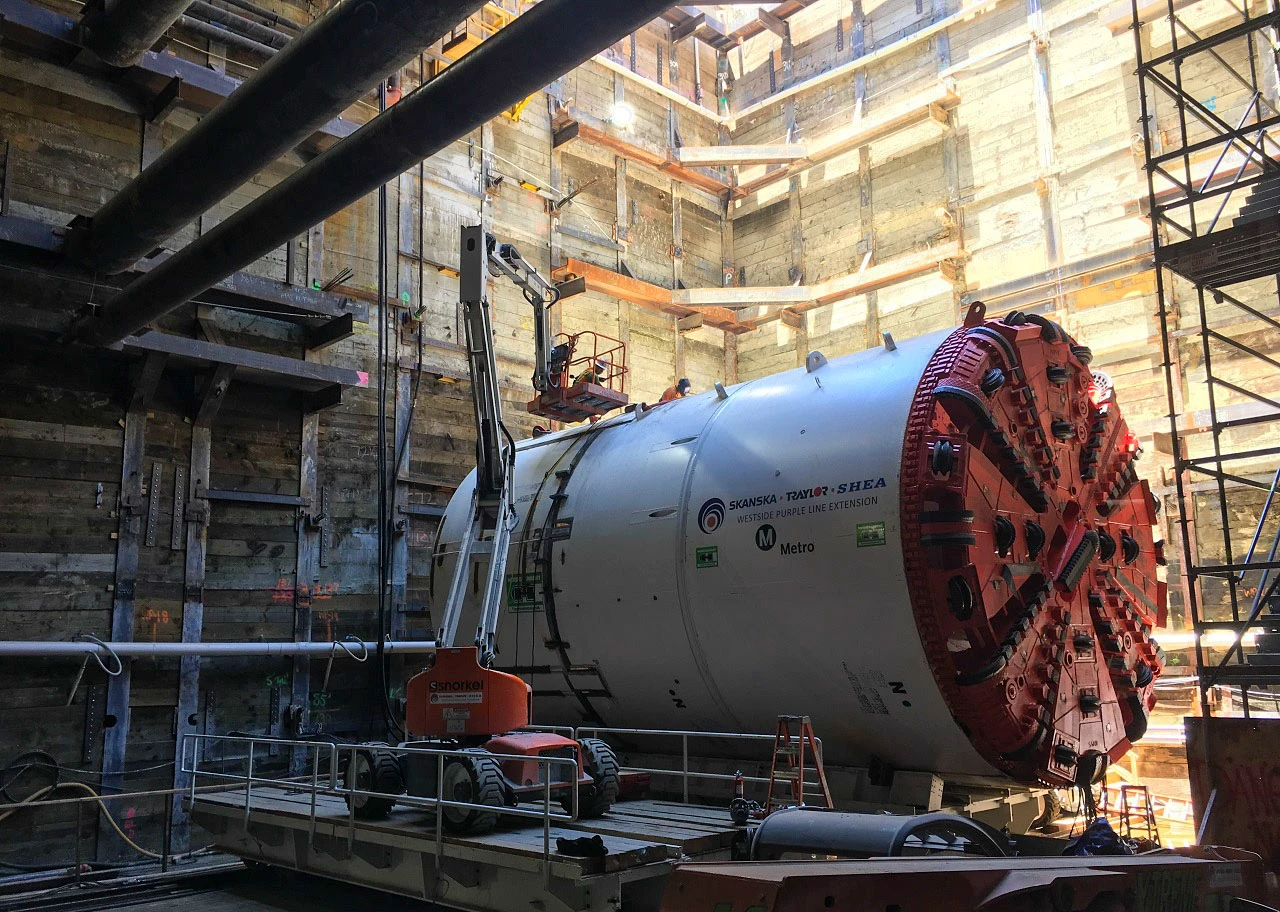
Tunnel boring machine at La Brea Station. Photo: LA Metro / Wikimedia Commons.

There are a few reasons why this is happening, and to be clear they’re perfectly valid reasons. The primary reason is convenience. Cities are a mess of existing tunnels, utilities, and sewers that are already running under the streets. A shallow tunnel and stations would require moving a substantial amount of these things, while a deeper tunnel can simply dig underneath them. With tunnel boring machines replacing cut and cover as the predominant method of construction, it’s also just easier to drill through bedrock rather than deal with more unpredictable ground near the surface.
The problem is not inherently that the subways are being dug too deep, but that the trade-offs are not being properly evaluated. It’s quite possible that the additional time and/or cost to deal with a shallower construction would not be worth it, but this seems too often to be assumed without taking the time to calculate what the cost difference would be or importantly the impact to the passengers.
Transport for London suggests a time perception factor of 4x on walking up stairs, 2.5x walking down stairs, and 1.5x standing on an escalator. This translates to a perceived time when standing on escalators of 6 seconds for each metre (3.3 ft). For a simple analysis we’ll just use this number – While some people walk, the perception of walking up stairs or an escalator is onerous enough in the TfL guidance that it would be perceived by most as less preferential to standing on the escalator.
Using the previously mentioned USDOT guidance, that implies that each metre of station depth adds ~3.75 cents per passenger. While on the surface this seems negligible, the metres and the passengers both add up. The three stations on phase one of the Second Avenue Subway for instance had 24.1 million riders in 2019. If it were possible to build the line at 50 ft (15 m) below ground rather than 100 ft (30m), that would have resulted in an additional $13.5 million in benefit per year, or an impressive $601 million over the lifecycle of the project – More than the effective travel time benefit of constructing Grand Central Madison.
Illustrative station-depth benefit: Approximately $13.5 million annually, or $601 million over the project lifecycle, for a hypothetical 15-metre reduction in station depth.
This isn’t to say that this is an easy solution, simply that the impacts of station access are very significant and should be weighed against the construction challenges of trying to build a shallower system. Transport planners too often forget the third dimension when looking at a map to calculate travel time impacts, but those impacts can often be as or more significant than the cross-city impacts that they’re trying to optimize for.
When access and egress benefits are underestimated
This station access problem isn’t just related to station depth – While we may commonly overstate travel time benefits due to insufficient focus on vertical circulation, in other situations we may understate them where we don’t consider knock on effects.

Vehicles queue in a parking garage. Photo: Pexels.

GO Transit is an example of a successful commuter rail agency that moves over 60 million passengers annually on GO Trains. To do this, they rely on large trains of Bombardier bi-level coaches that can collectively hold over 2000 people on a single train. While the long-term goal is to move to a more bi-directional all-day service, at its core it still serves as a way for suburban commuters to get in and out of the city, with roughly half of its users driving and parking at stations.
If GO were to evaluate a change in service levels, the obvious calculation for planners to make would be on wait times. Assuming train speeds remain the same, if a customer used to wait on average 15 minutes and now they wait 10 minutes, there would be a benefit of five minutes multiplied by all the passengers on the line.
This understates the potential benefit because of egress. If you’ve ever been a customer at a commuter railway station anywhere in North America you’re probably familiar with the rapid sprint to your car to try to get out before the traffic builds up with potentially hundreds of cars trying to exit through a limited number of opportunities, not always traffic controlled. To get from a 15 minute wait to a 10 minute wait the number of trains would have had to increase by 50%. But ridership is not that elastic, and while ridership will undoubtedly go up with the better service, it’s unlikely to go up by more than 50%. This means that effectively an increase in service doesn’t just improve wait times, but it improves egress times as the load per train decreases.
Let’s assume that instead of 800 driving-access passengers getting off 2 trains (400 per train) we now have 900 getting off 3 trains (300 per train). While the total ridership has increased, ridership per train has decreased. Assuming two equally used exits and an optimistic 4 seconds per vehicle to leave an exit, it would take a little over 13 minutes to clear the parking lot in the “before” scenario, with an average wait time of 6 minutes and 40 seconds per vehicle. In the new scenario, we now would see it taking 10 minutes to clear the parking lot with an average wait time of 5 minutes per vehicle. Once again, these benefits are significant and often not accounted for – While they may not be likely to surpass the direct wait time impact of the trains themselves, they are substantial and worth calculating, and may be even higher than the relatively quick egress assumed in this example.
Measuring the whole journey
Too often, we as planners become fixated on the primary goals of a project, losing sight of other impacts on passengers simply because they weren't part of the original scope. We may be trying to move people from A to B, but A and B aren't train platforms. They're the places people are actually trying to get to and from, and everything that happens between those points matters.
In New York, that oversight can make an $11.6 billion investment look considerably more beneficial than it is. At a suburban GO station, the same oversight can cause us to undervalue an improvement in train frequency. In both cases, the problem isn't necessarily the investment itself, but the incomplete picture we're using to evaluate it.
The implications go well beyond a few minutes of travel time. They can influence whether we build a station 15 or 30 metres underground, whether we invest in additional service, and ultimately where billions of dollars in public funding are directed.
The goal of transportation planning isn't to get people from one platform to another. It's to get them where they want to go. Our evaluations should reflect that.
Supporting analysis